


State Key Laboratory of Optical Quantum Materials
Research Highlights
Bringing together nanophotonics, quantum materials and quantum systems to explore new light–matter phenomena and develop methods for optical control, quantum-state manipulation and integrated optoelectronic devices.
Featured Discovery
2026 Nature Nanotechnology
Magnetically mediated excitonic negative refraction
Changing light propagation through magnetic order in a quantum material.
Researchers observed excitonic negative refraction in the layered magnetic semiconductor CrSBr and demonstrated an excitonic hyperlens on an integrated nanophotonic chip. By enhancing excitonic resonances, magnetic order enables unusual light propagation, establishing a material platform for optical control at the nanoscale.
Related researchers: Nicholas Fang, Xiaobo Yin, Shuang Zhang, Xiaodong Cui, Xiang Zhang and collaborators
Excitonic negative refraction mediated by magnetic ordersRead the original paper ↗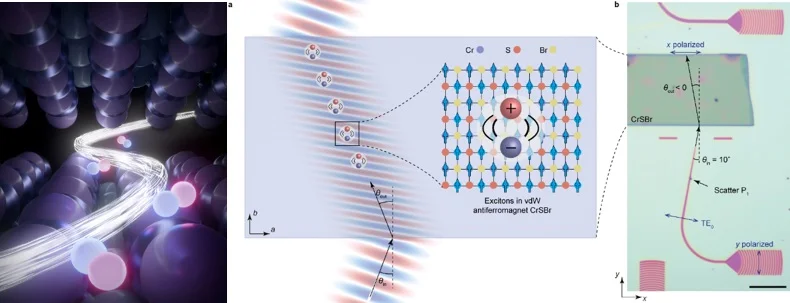
Selected Research Highlights
Selected advances spanning photonic structures, quantum light sources, quantum-material growth and ultracold systems.
Quantum photonics
Metasurface-based high-dimensional quantum light sources
Integrating a multipath photon-pair source with a metalens array.
A metalens array integrated with a nonlinear crystal produces a 100-path spontaneous parametric down-conversion photon-pair source in a 10 × 10 array. The work demonstrates two-, three- and four-dimensional two-photon path entanglement, providing a platform for compact high-dimensional entanglement sources and multiphoton-state generation.
2020 Science
Related researchers: Din Ping Tsai and collaborators
Metalens-array-based high-dimensional and multiphoton quantum sourceRead the original paper ↗Electron–light interaction
Photonic flatbands enhance free-electron radiation
Enhancing electron–light coupling with photonic-crystal resonances.
Photonic flatband resonances engineered in a silicon photonic-crystal slab enable energy–momentum matching and enhanced free-electron radiation through control of electron trajectories and velocities. The work provides an experimental platform for compact free-electron light sources and studies of electron–photon interactions.
2023 Nature
Related researchers: Yi Yang and collaborators
Photonic flatband resonances for free-electron radiationRead the original paper ↗Integrated optoelectronic devices
Three-dimensional integration of ultralow-noise lasers
Realising low-noise, isolator-free light sources on a silicon photonics platform.
Three-dimensional integration brings III–V gain materials, silicon photonic devices and ultralow-loss silicon nitride waveguides onto a single chip. A high-quality-factor microresonator reduces laser noise and enables isolator-free operation, advancing the integration of highly coherent light sources and complex photonic systems.
2023 Nature
Related researchers: Chao Xiang and collaborators
3D integration enables ultralow-noise isolator-free lasers in silicon photonicsRead the original paper ↗
Nanophotonics
Synthetic complex-frequency waves improve superlens imaging
Using virtual gain to compensate for the effects of loss on imaging.
Multifrequency measurements are combined to synthesise temporally decaying complex-frequency waves, introducing virtual gain to mitigate the effects of material loss on superlens imaging. The experimental demonstration of deep-subwavelength imaging establishes a method for improving the performance of lossy nanophotonic systems.
2023 Science
Related researchers: Shuang Zhang, Xiang Zhang and collaborators
Overcoming losses in superlenses with synthetic waves of complex frequencyRead the original paper ↗Quantum degrees of freedom
Optical valley control in monolayer semiconductors
Selectively exciting different valleys with circularly polarised light.
Circularly polarised light generates valley polarisation in monolayer MoS₂, with polarisation-resolved luminescence used to read out the valley response. The work demonstrates the feasibility of optical valley control and provides an experimental foundation for valley electronics and optoelectronics.
2012 Nature Nanotechnology
Related researchers: Xiaodong Cui, Wang Yao and collaborators
Valley polarization in MoS₂ monolayers by optical pumpingRead the original paper ↗
Materials growth and integration
Wafer-scale epitaxy of single-crystal 2D semiconductors
Growing large-area, single-crystal monolayers at relatively low temperatures.
Molecular-beam epitaxy produces wafer-scale single-crystalline MoSe₂ and WSe₂ monolayers on Au(111) at 200–400 °C. The study examines island–substrate interactions and the role of surface steps, expanding methods for large-area growth of high-quality two-dimensional semiconductor films.
2023 Natural Sciences
Related researchers: Maohai Xie, Xiaodong Cui, Dong-Keun Ki and collaborators
Wafer-scale single-crystalline MoSe₂ and WSe₂ monolayers grown by molecular-beam epitaxy at low-temperature — the role of island-substrate interaction and surface stepsRead the original paper ↗Quantum materials
Tuning superconductivity through chiral molecular intercalation
Expanding superconductor design through molecular chirality.
Chiral molecules intercalated between TaS₂ layers form hybrid superlattices of alternating molecular and atomic-crystal layers. Experiments reveal signatures consistent with unconventional superconductivity, opening a route to investigating and tuning quantum materials through molecular intercalation.
2024 Nature
Related researchers: Zhong Wan and collaborators
Unconventional superconductivity in chiral molecule–TaS₂ hybrid superlatticesRead the original paper ↗
Ultracold quantum systems
From atomic to molecular condensates
Realising a transition between atomic and molecular condensates in an ultracold gas.
Tuning pairing interactions in an atomic Bose–Einstein condensate enables the preparation of a two-dimensional Bose–Einstein condensate of rotating molecules and a transition between atomic and molecular condensates. The work provides a controllable platform for investigating quantum-degenerate molecular gases and many-body interactions.
2021 Nature
Related researchers: Zhendong Zhang and collaborators
Transition from an atomic to a molecular Bose–Einstein condensateRead the original paper ↗Foundational Advances
Discover works that have expanded optics and quantum physics. Select a topic to explore the advances.
Metamaterial photonics and subwavelength opticsExpand / collapse
Controlling light propagation, focusing and confinement with engineered structures.
2005 Science
Sub-diffraction imaging with a silver superlens
A silver-film superlens enhances evanescent fields to achieve near-field imaging below the diffraction limit, demonstrating the ability to resolve nanoscale details.
Sub–Diffraction-Limited Optical Imaging with a Silver SuperlensRead the original paper ↗2008 Science
Optical negative refraction in silver-nanowire metamaterials
Silver nanowires embedded in alumina form an anisotropic bulk metamaterial that exhibits negative refraction at visible wavelengths, demonstrating a route to controlling light propagation through engineered structures.
Optical Negative Refraction in Bulk Metamaterials of NanowiresRead the original paper ↗2009 Nature
Deep-subwavelength plasmonic lasers
Hybrid plasmonic modes formed by semiconductor nanowires and a metal surface confine light at deep-subwavelength scales and enable lasing, advancing research on miniature coherent light sources.
Plasmon lasers at deep subwavelength scaleRead the original paper ↗Two-dimensional materials, topological states and devicesExpand / collapse
From the fundamental properties of electrons and excitons to materials preparation and optoelectronic control.
2009 Physical Review Letters
Topological Anderson insulator
Theoretical work proposed that disorder can induce a topological insulating state under specific conditions, opening a route to controlling topological phases through disorder.
Topological Anderson InsulatorRead the original paper ↗2011 Nature
Broadband high-speed graphene optical modulators
Monolayer graphene integrated with a silicon waveguide enables electrically controlled optical absorption, demonstrating a compact electro-optic modulator with a broadband response.
A graphene-based broadband optical modulatorRead the original paper ↗2014 Nature
Strongly bound excitons in monolayer WS₂
Spectroscopic measurements combined with theoretical analysis reveal dark exciton states and an exciton binding energy of approximately 0.7 eV in monolayer WS₂, deepening understanding of optical excitations in two-dimensional semiconductors.
Probing excitonic dark states in single-layer tungsten disulphideRead the original paper ↗Quantum vacuum and nanoscale interactionsExpand / collapse
Exploring how quantum fluctuations influence energy transfer and the motion of small objects.
2019 Nature
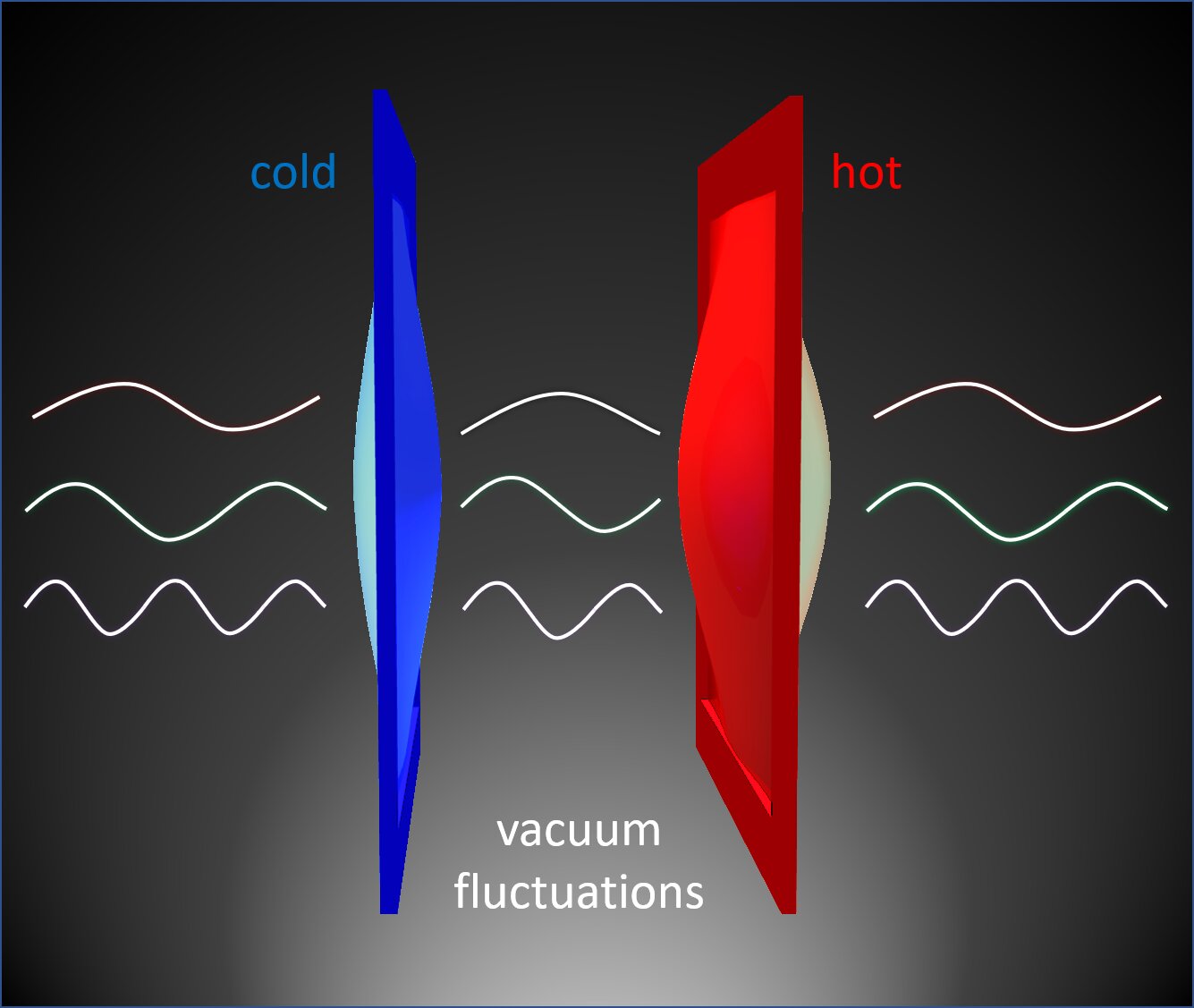
Phonon heat transfer across a vacuum gap
Experiments demonstrate phonon heat transfer across a vacuum mediated by quantum fluctuations, revealing a mechanism for energy exchange at the nanoscale.
Phonon heat transfer across a vacuum through quantum fluctuationsRead the original paper ↗
2019 Science
Stable Casimir equilibria and passive trapping
Material and thin-film design tune the balance between attractive and repulsive Casimir interactions at different separations, enabling stable equilibrium and passive nanoscale trapping without external energy input.
Stable Casimir equilibria and quantum trappingRead the original paper ↗Recent Research
Selected recent papers, ordered by publication date.
2026-01-29
Physical Review Letters
Theoretical research
Cavity-vacuum symmetry breaking and moiré quantum states
Mean-field and exact-diagonalisation calculations predict that coupling a cavity vacuum to moiré superlattices can produce spontaneous parity-symmetry breaking and gyrotropic effects.
Related researchers: Shuang Zhang, Wang Yao and collaborators
Spontaneous Symmetry Breaking of Cavity Vacuum and Emergent Gyrotropic Effects in Embedded Moiré SuperlatticesRead the original paper ↗2026-01-14
Nature Communications
Spectroscopic methods
Synthetic gain enhances electron-beam spectroscopy
Synthetic complex-frequency methods applied to electron energy-loss and cathodoluminescence spectroscopy recover resonances hidden by background signals, improving spectral identification and imaging of nanostructures.
Related researchers: Shuang Zhang, Yi Yang and collaborators
Synthetic gain for electron-beam spectroscopyRead the original paper ↗2025-08-18
Nature Communications
Ultrafast spectroscopy
Noncollinear harmonic spectroscopy tracks strong-field effects
Noncollinear harmonic spectroscopy initiates, tracks and steers femtosecond carrier dynamics in SiO₂ crystals, revealing the crossover between different strong-field effects.
Related researchers: Tran Trung Luu and collaborators
Noncollinear harmonic spectroscopy reveals crossover of strong-field effectsRead the original paper ↗2025-01-02
Nature Communications
Metamaterials
Gigantic Tellegen responses in metamaterials
Experiments realise a metamaterial with a pure Tellegen response, demonstrating strong magnetoelectric coupling and nonreciprocal polarisation behaviour that expand the functionality of engineered electromagnetic materials.
Related researchers: Shuang Zhang and collaborators
Gigantic Tellegen responses in metamaterialsRead the original paper ↗